
Book Review: The Codex of Christian Surname
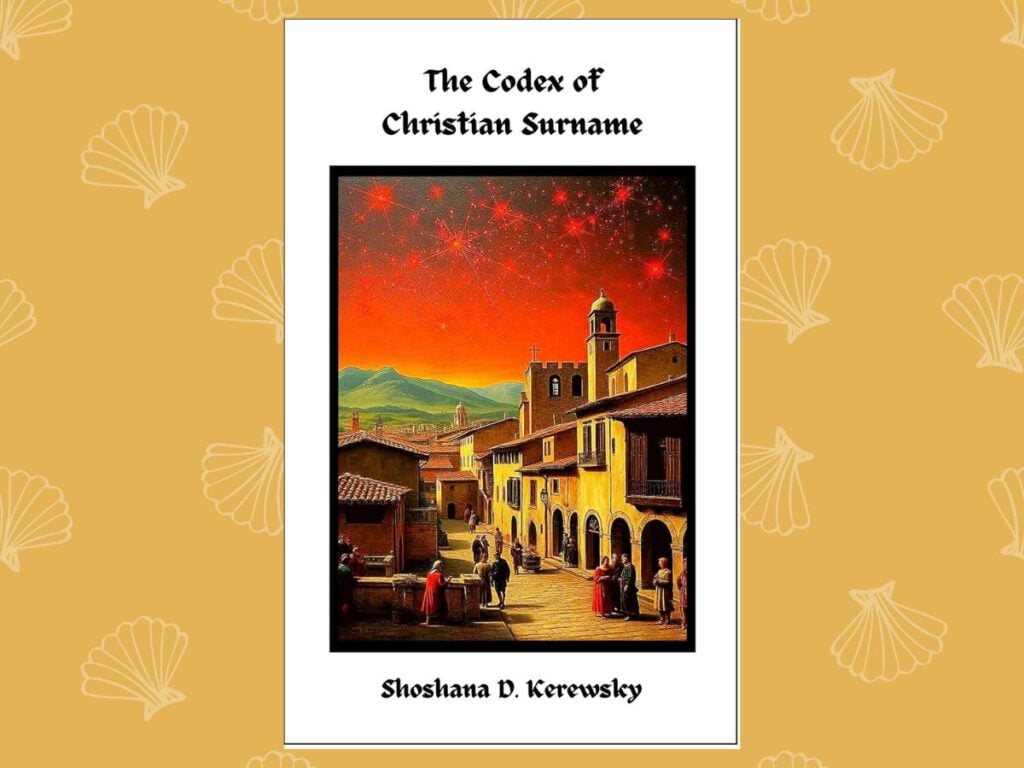
The Codex of Christian Surname
by Shoshana D. Kerewsky
Lockweed Press, 2026
380 pages
on Goodreads
Reviewed by Amy Horton | Warrenton, MO
Having previously read Shoshana D. Kerewsky’s other Camino-related works, a memoir and a collection of poetry and reflections, I anticipated her debut novel would be similarly intricate, textured, and varicolored. It is all those things and more.
From the first line, readers are drawn into this tale set in an alternate late Middle Ages Spain, where we meet the narrator and protagonist as 13-year-old Havah. Orphaned and living with aunts, uncles, and cousins in a small town near a pilgrim route to Santiago de Compostela, Havah inhabits a simple life working in her family’s butchery and is meant to marry a cousin. Still, she feeds an insatiable hunger to learn by eavesdropping on her uncle’s rabbinical lessons for the boys attending his yeshiva and furtively reading books and codices when cleaning his study. Then an intriguing stranger arrives in town, setting Havah’s saga in motion.
Distinguished from the archetypal Hero’s Journey story structure famously identified by mythologist Joseph Campbell, the narrative inscrolled in Codex more closely resembles what historical fiction author Mary Sharratt and other scholars of the sacred feminine describe as a Via Feminina. In the hero’s journey story arc, the protagonist goes on a quest, transforms through a decisive crisis, and victoriously returns to share his hard-won knowledge with those back home. By contrast, a Via Feminina “steps away from goal-driven narratives of conquest and opens space for an ancient, sacred spiral—a journey of ascent toward full flourishing” (Journey Home, 2026).
Codex occurs in the waning days of a religious Convivencia in medieval Iberia—a perfect setting for the protagonist to explore her own Jewish culture and delve into aspects of Christianity, Islam, and even Buddhism. Codex is also gender bending, with Havah and her companion assuming various alternate identities as needed to advance the plot. The protagonist at turns presents as a pilgrim boy walking toward Santiago de Compostela, a girl who can easily blend in amongst a sheik’s harem, a boy studying at synagogue, a man on pilgrimage to Rome, and as a monastic scribe. And there are times when the protagonist is unsure whether their shapeshifting companion is a trusted guide or a pied piper.
Codex is also a lexical playground, unsurprising given that Kerewsky holds a linguistics degree (among others). The text is rich with vocabulary not always common in today’s vernacular, but which deliciously flavors the story and steeps the reader in the protagonist’s world. Kerewsky, appearing as a fictionalized version of herself—Profesora Xoxana D. Kerewsky, editor/translator of the Codex—acknowledges Codex’s linguistic complexity in the book’s front matter, trusting “that readers’ intelligence and education will allow them to infer non-Anglish and obscure words from context.” That is often so, though I’m also self-assured in having occasionally referenced a dictionary to confirm or clarify a term. As one GoodReads reviewer of Codex observes, Kerewsky is “astonishingly well-versed in world religions, languages, geography, history, philosophy, mathematics and more. Inevitably, much of their knowledge (and polysyllabic vocabulary!) finds its way into their layered story-telling. As a reader of these works, I knew I was missing much … and so simply embraced the stories at my own level of comprehension.”
And while Codex is enchanting, readers may also identify with the protagonist, who sometimes grows frustrated by what seems like an inexplicably circuitous and wearisome journey. As their companion explains: “I know it frustrates you” … “Will you believe me that there are very important reasons?” So, too, readers must trust that Kerewsky has good reason for every plot twist and turn of phrase that illuminates this shimmering tale.
Editor’s note: Find reviews of Shoshana D. Kerewsky’s previously Camino-related books in past La Concha issues:
- Spring 2024: 50 Days in May: Reflections Along the Camino de Santiago (Lockweed Press, 2024)
- Autumn 2022 (page 37): Cancer, Kitsugi, Camino (Lockweed Press, 2022).
Explore More of the Autumn 2026 Issue
More Book & Film Reviews
-
 Book & Film Reviews
Book Review – Yellow Arrows
-
 Book & Film Reviews
Book Review – The Way Beneath Your Feet
-
 Book & Film Reviews
Book Review: The Codex of Christian Surname
-
 Book & Film Reviews
Book Review – The Joyful Gypsy Gal
Got a book or film to review? Let La Concha know!
Have you published a Camino- or pilgrimage-related book that La Concha has not yet reviewed? Did you produce a film on the subject that you want fellow pilgrims to know about? If you are an American Pilgrims member, drop an email to laconcha@americanpilgrims.org with the title and a brief synopsis of your creative work, and we will connect you with one of our reviewers for consideration. You can check your membership status here, or learn more about becoming a member here.