
Arrows Hidden in Plain Sight
Arrows Hidden in Plain Sight
by Sharon & Jim Porter | Caldwell, ID
Having walked the traditional Camino Francés twice, we decided to do something different this year. We began our Camino in Santiago and made our way onto the Camino Muxía. Reaching Muxía, we returned by bus to Santiago, then continued on to Ferrol to begin the Camino Inglés. For the two of us, this proved the perfect way to break back into the familiar rhythm of the Camino.
Finishing the Camino Inglés brought us once again to the Praza do Obradoiro. We then caught a train to Ponferrada the following day. That’s where things got interesting—and gave us a new appreciation for the Camino Francés. We walked away from Ponferrada towards St. Jean Pied de Port rather than towards Santiago.
While Sharon had long harbored a not-so-secret desire to walk from Santiago to St. Jean, Jim came around to the idea after watching vlogger Efrén González’s video series highlighting his walk of the Camino Francés in reverse. Most of our reverse journey was spent walking from Ponferrada to Pamplona, which proved to be both challenging and rewarding in unexpected ways.
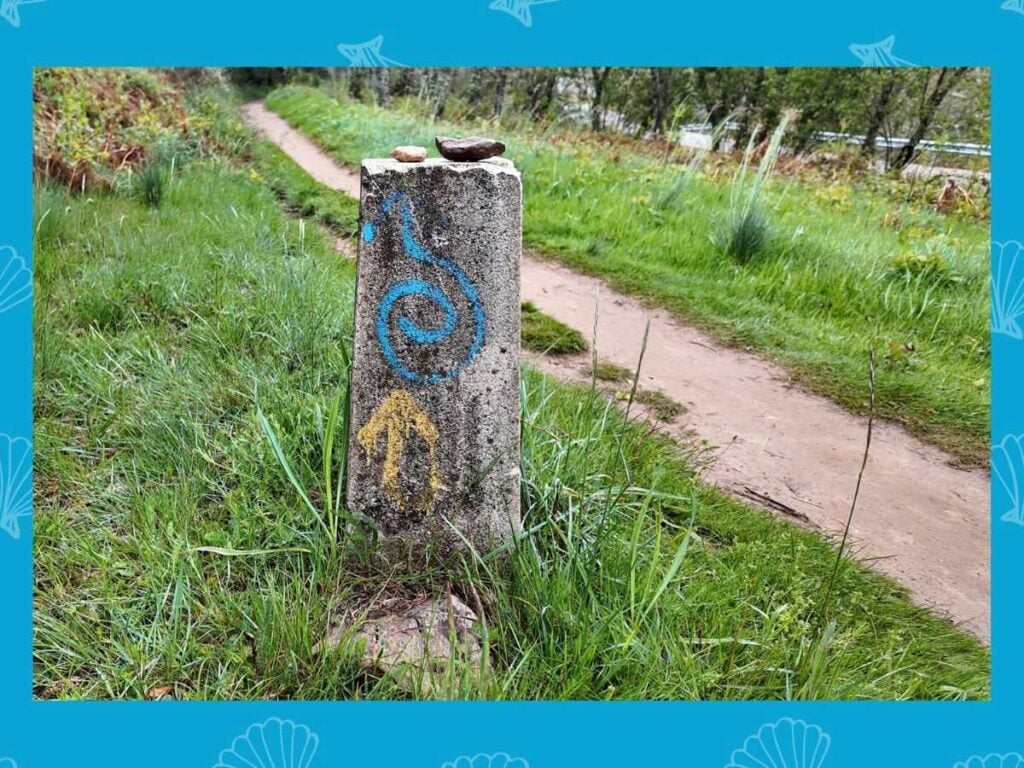
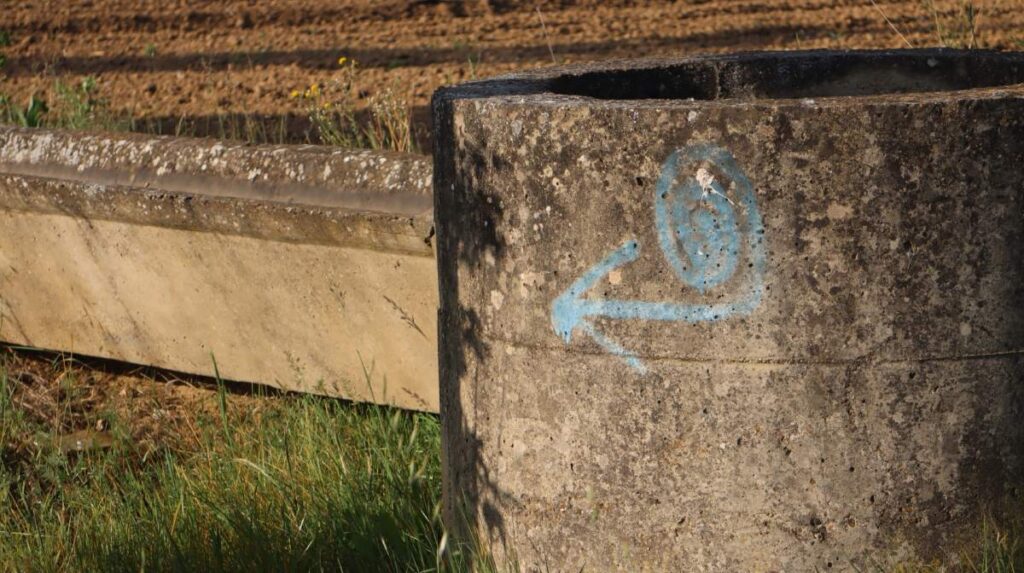
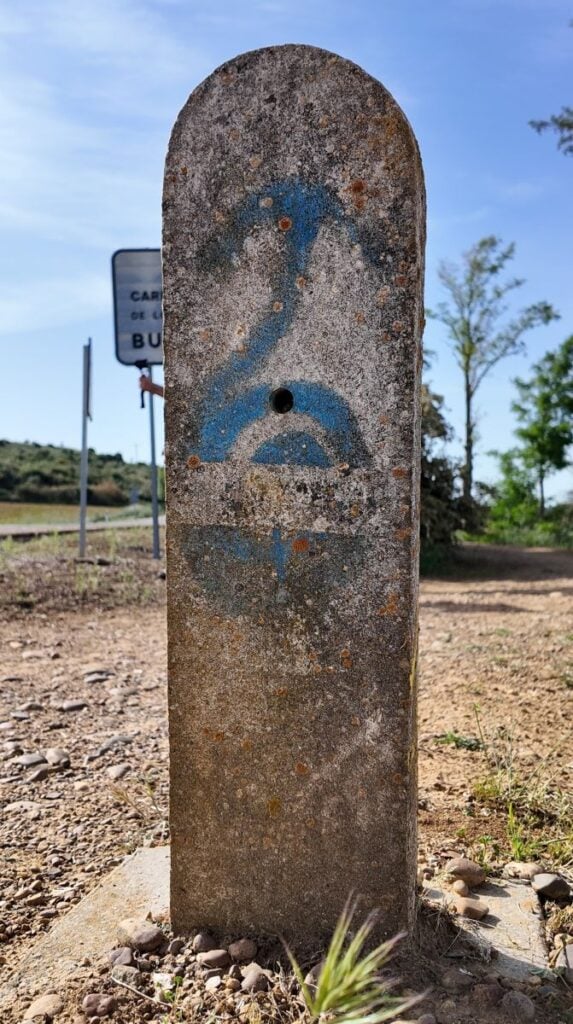
On the Camino, arrows are a pilgrim’s best friend. Santiago-bound pilgrims constantly scan for the next familiar yellow arrow. As you might imagine, that’s not quite so easy in reverse. When you’re walking against the current, arrows are sometimes invisible to you. However, through Efren’s series we learned of the Camino reverse code: the blue spiral arrow.
They’re nowhere near as abundant, but they are there—smaller, a little more artistic perhaps, and often elusive. Yet each one brought the same instant relief, quieting the familiar whisper: Are we lost? Because they were rare, each sighting became a celebration and photo-op. We’re not lost. Someone has gone this way before us.
Whether we felt sociable or wanted to keep to ourselves, one of our unexpected pleasures in walking against the current was meeting thousands of pilgrims heading toward Santiago. This meant offering a “Buen Camino” to each passing peregrino—uttering that familiar encouragement literally hundreds of times each day. If it sounds like fun, it is… for about the first 50 or 60 times. Then, not so much.
We became surprisingly good at reading people. Were they having a good day? Were they tired? Struggling? Looking for conversation, or content with their thoughts? Should we offer the first “Buen Camino” or simply smile and let them pass?
We fielded plenty of questions. Some pilgrims worried they must be going the wrong way. Others wanted to know why we were walking the Francés in reverse or what awaited them later that day. We were happy to reassure them that yes, they were headed toward Santiago, that beds awaited in the next town, and that our walk away from Santiago was entirely intentional. We never did come up with a good retort to the one pilgrim who insisted we were doing it wrong.
Our opposing journey wasn’t about being different; it was about changing our perspectives. The blue arrows were rare and reassuring, visible only because of the path we’d chosen. Walking away from Santiago didn’t change the Camino; it changed what we noticed, how we encountered others along the way, and how we dealt with uncertainty along a path we thought we already knew.
Sometimes the blue arrows showed us the way. When they didn’t, the endless stream of pilgrims walking toward Santiago reminded us that we were exactly where we were supposed to be.
Explore More of the Autumn 2026 Issue
More Pilgrims Way
-
 Pilgrims Way
Walking in Solitude but Never Alone
-
 Pilgrims Way
The Way With Parkinson’s Disease
-
 Pilgrims Way
The Pilgrim in the Mirror
-
 Pilgrims Way
Led & Held Through Grief to the Camino