You’ve got Camino Questions: How crowded will it be? Which month is busiest? Which routes are busiest? Where is everyone from? Or maybe you just love charts and numbers!
Well, we’ve got some data for you. This Camino de Santiago statistics page is designed to help you gain a greater understanding of the Camino and help to inform your decision making about route and timing.
High-Level Pilgrim Statistics
For our analysis, we’re just looking at the high-level stats and the more popular routes and start points. For a deeper dive, we encourage you to check out the full data set published by the Pilgrim’s Reception office in Santiago. We pull these stats in January. There is sometimes data lag, so please consider this analysis a moment-in-time snapshot of 2025.
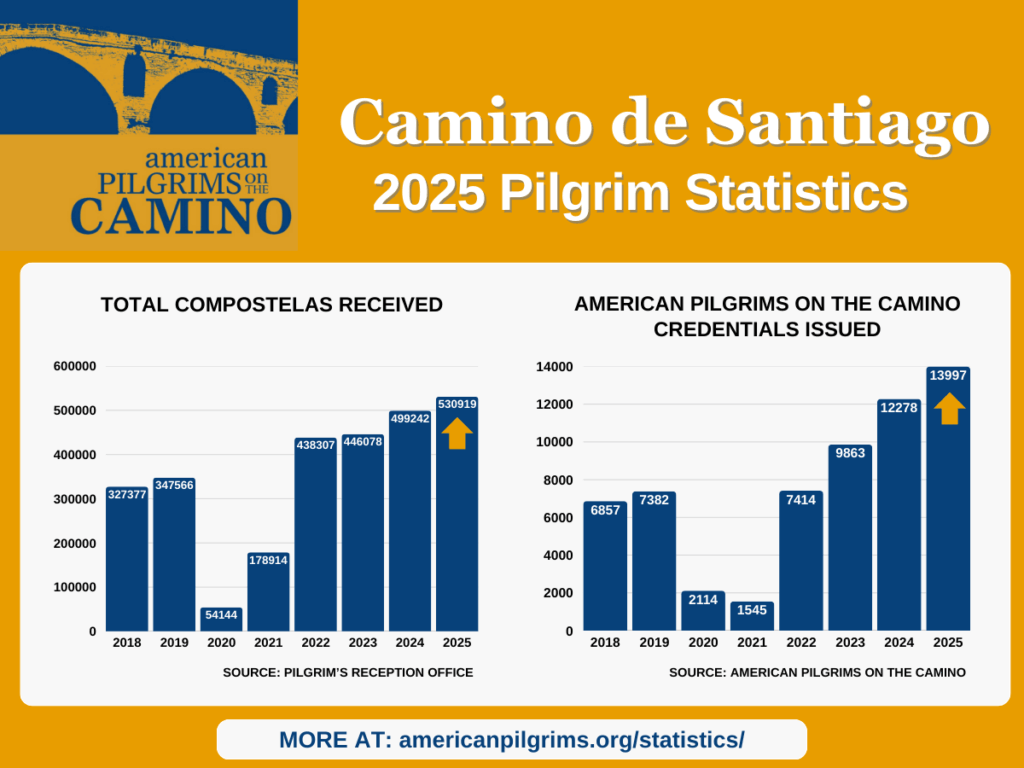
The Pilgrim’s Reception Office reported 530,919 pilgrims receiving a Compostela in 2025. This is a 6% increase over 2024 and 90% more than 10 years ago. It’s also worth noting that while the Camino grew overall in 2025, the 2023/24 growth rate was higher at +12%. It’s hard to say exactly why, but there was definitely a boost of US pilgrims in 2024 and it’s also possible that the post-COVID catch-up was still happening that year. Whatever the cause, the Camino certainly isn’t static – how and where pilgrims are experiencing it is always evolving.
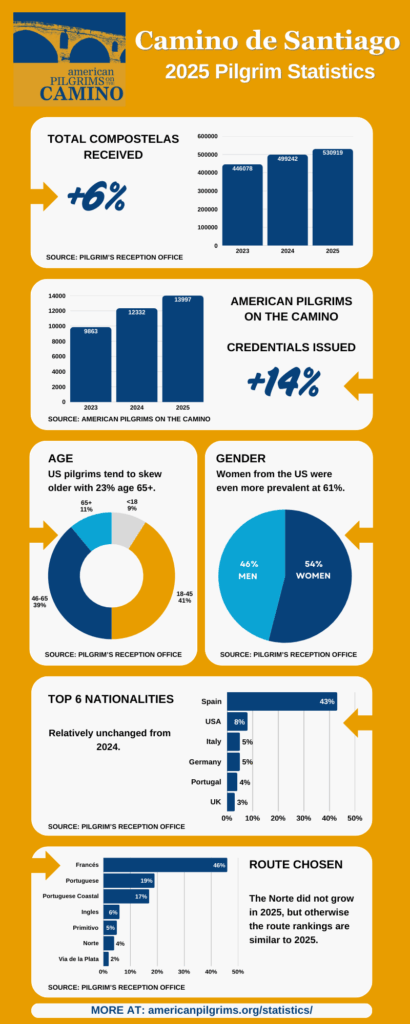
For instance, for the third year in a row, the traditional Francés route has grown more slowly than the combined Portuguese routes (Central and Coastal). Year-over-year, the Francés was up 2%, while the Portuguese Coastal was up 20%. There was also higher growth on the Inglés (+8%) and the Primitivo (+14%).
We’ve continued to see growth in start points that meet the traditional 100 km sweet spot. 51% of pilgrims report starting in Sarria, Ferrol, Vigo, or Tui/Valenca do Mihno. Although with last year’s change to the Compostela requirements, we could start seeing a shift. Pilgrims starting in Sarria represented 31% of total 2025 pilgrims who sought a Compostela. If many choose to take advantage of the new rules, they may start further back on a number of routes.
One disadvantage to the Pilgrim’s Reception Office statistics is that they can only count people who request a Compostela in Santiago. The methodology can’t measure pilgrims who go on a Camino route but who don’t end up in Santiago, or those who do end up there but don’t request a Compostela.
In 2024/5, the Galician government ran an interesting experiment. They posted 25 sensors that anonymously pinged mobile phones along the various pilgrim routes that run through Galicia. They were placed in locations that were more likely to capture pilgrims than the general public. That data suggests that counting only Compostela-seekers may under-represent the total pilgrim count by as much at 40%!
The St. Jean Pilgrim office also counts people who visit their welcome center. For 2025, they reported 54,115 pilgrims. The Santiago office only counted 30,345. So, those 23,770 extra pilgrims are stopping somewhere before reaching Santiago.
Here’s an infographic that we’ve created to illustrate some of these stats. And you can scroll further for more detail.
And What Are the US Pilgrims Up To?
Here at American Pilgrims on the Camino, we also have our own metrics, which we gather through our credential request program. In 2025, we received 13,997 credential requests, which represents ~30% of the US pilgrims who ended up in Santiago (noted above). This was a 14% growth over 2024 and 96% growth in the last 10 years.
For the first time in 2024, pilgrims from the US became the second most prevalent nationality (8%) after the Spaniards (42%). This held steady in 2025. The US Pilgrims are also different demographically. US women represent a higher percentage than globally (61% vs 54%).
We also tend to skew older with 71% of US pilgrims being age 46+ vs 50% globally. Certainly the large Spanish school groups who walk during the summer will skew younger. But even the Italians and Germans tend to be younger than the US pilgrims. Perhaps this has to do with the lower amount of vacation time that US workers receive relative to our European counterparts.
Are more Americans waiting until retirement so that they have time for a longer Camino? Maybe so, because US pilgrims are also twice as likely to start in St. Jean.
4 Camino Stats: Myths and Misunderstandings
We see a lot of opinions and advice about the Camino in our own Facebook group and around the web. Usually, those opinions offer genuinely helpful advice about when, where, how, or why to go on the Camino. But sometimes, that advice can be rooted in personal experience and not reflective of the Camino at large. Here are a few things that the data tells us:
1. “May, August and September are the Worst/Busiest Months to Go”
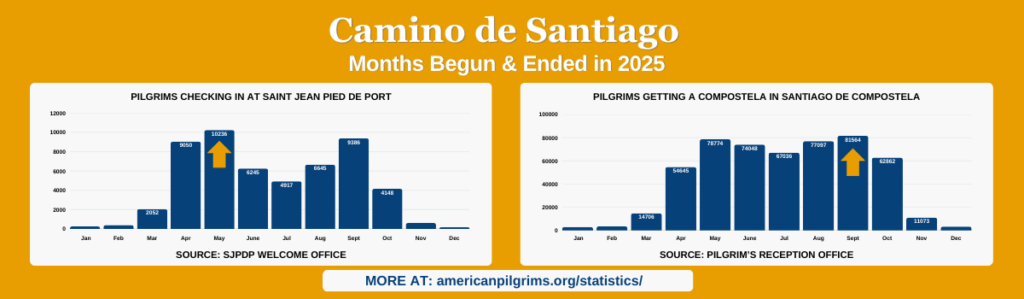
83% of pilgrims arrive in Santiago between May and October (source: Pilgrim’s Reception Office). And it’s true that those who start in Sarria or Tui are more likely to do so in August and September. But that isn’t necessarily the case on the longer routes.
86% of pilgrims who started in St. Jean did so between April and September (source: St. Jean Welcome office). April, May, and September are somewhat busier than June through August, but not drastically so.
Our advice: Go whenever it’s convenient for your schedule and your personal tolerance for the weather.
2. “Too Many People Start from Sarria, Making it too Busy”
Sarria is indeed the most popular starting point, with 31% of pilgrims beginning their journey there (source: Pilgrim’s Reception Office). But this means that 69% are starting somewhere else. This section of trail is not busy solely because of the people starting in Sarria. It’s busy because it’s the confluence of the Francés, Primitivo, Norte, and a variant of the Via de la Plata. All of them connect in or just after Sarria.
Our advice: You can certainly get a bed or find tranquility by deploying strategies like:
- Be flexible. Staying off of the typical guidebook stages allows you to slip into quiet pockets of the trail.
- Stay in municipal or parroquial albergues. Many pilgrims on this section make advance reservations and/or have luggage portaged. Municipal and parroquial albergues allow neither.
- Be openhearted about sharing your space with other pilgrims.
- Take advantage of the new Compostela rules by starting further back on one of the longer trails (like the Francés or Norte) and then jump ahead for that last qualifying stage.
3. In Order to “Do the Whole Thing”, You Have to Start in St. Jean
The Camino is a very personal journey, and there is no “whole thing” other than however you choose to define it. This should take into account factors like how much time you have and your personal goals for the pilgrimage.
St. Jean is a lovely French village and a great place to start the Camino Francés, but it’s just one of many possible places to start this popular route.
Last year, on a “pick your distance” adventure, nearly 23,000 pilgrims started in Roncesvalles, O’Cebreiro, Leon or Ponferrada. This gave them plenty of distance for a long, satisfying pilgrimage.
Our advice: Choose a starting point that serves your personal goals, making sure it fits in with your timeframe and personal fitness. The Camino apps can help you figure out the distances.
4. The Camino is for People Who are Walking
Indeed, 93% of the pilgrims who received a compostela last year did so by arriving on foot. But there’s also been proportional growth in people arriving by bike, horse, sailboat, and wheelchair (in that order).
We recognized these efforts, and in 2024 and 2025, our Grants program awarded two grants totaling $12,000 for a transport van and all-terrain motorized wheelchairs to the Caminos Adaptivos and Asociacion Discamino de Santiago programs.
Learn More About the Camino
- The history of the Camino.
- Planning your Camino.
- Camino route overviews.
- Get inspiration from our quarterly web magazine, La Concha.